When I was in New Zealand, I was pressed for time and I had to choose between two Sounds on the South Island. It was not an easy decision. Milford Sound is visited by thousands of tourists every year and for good reason: it’s stunning. Doubtful Sound is ten times less famous and ten times as big.
I think I made the right decision…

Doubtful Sound
As New Zealand enthusiast Amanda at A Dangerous Business pointed out, Doubtful Sound has too long been overshadowed by its more famous brother, Milford Sound.
In order to get to Doubtful Sound, one must ferry across Lake Manapouri (which I have since learned is home to prehistoric, slightly man-eating eels) to the Manapouri Underground Power Station, then transfer to a bus to drive 40 minutes along the length of Wilmot Pass Road through misty temperate rainforests brimming with prehistoric-sized ferns to the wharf at Doubtful Sound, where one may then take a 3-4 hour cruise out through the Sound to the Tasman Sea.
The underground power station, which looks like a James Bond villain’s lair, produces 15% of New Zealand’s power, 85% of which is used by an aluminum smelting facility in Bluff. The hollowed-out 2 km tunnel leading into the station was pretty impressive. The tunnel took 2 years to build and because the rock was mostly quartz and granite, they had to blast it out the entire way! Trivia fact: the rubble was used to pave the Wilmot Pass Road.
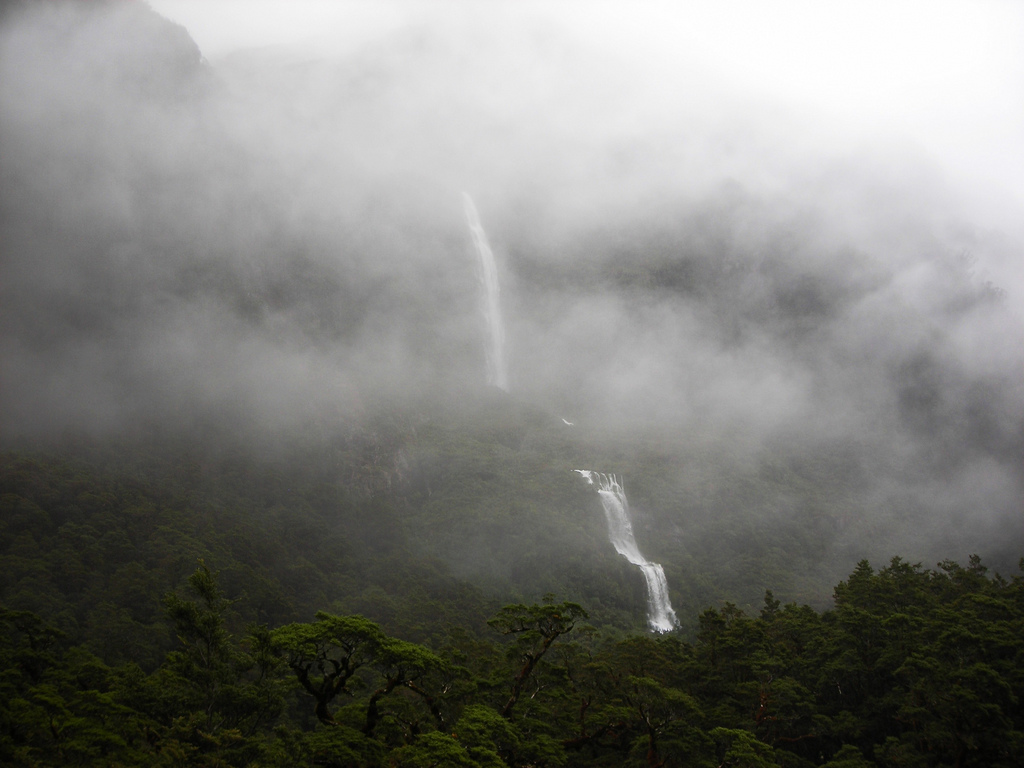
The Sound itself is not actually a Sound (a drowned river valley taken over by the sea once the glacier retreats), but rather a Fjord (land carved by glacier, filled in by sea). Doubtful Sound’s water comes from 3 places. First, the Tasman Sea. Second, the 5-9m of monthly rainfall that the temperate rainforest filters it to the ground to travel via hundreds of streams of waterfalls carrying the rainwater to the Sound’s basin. Third, the power station diverts the water from Lake Manapouri that churns its turbines to generate electricity through the mountain into a manmade river that empties into Deep Cove, the harbour for Doubtful Sound.
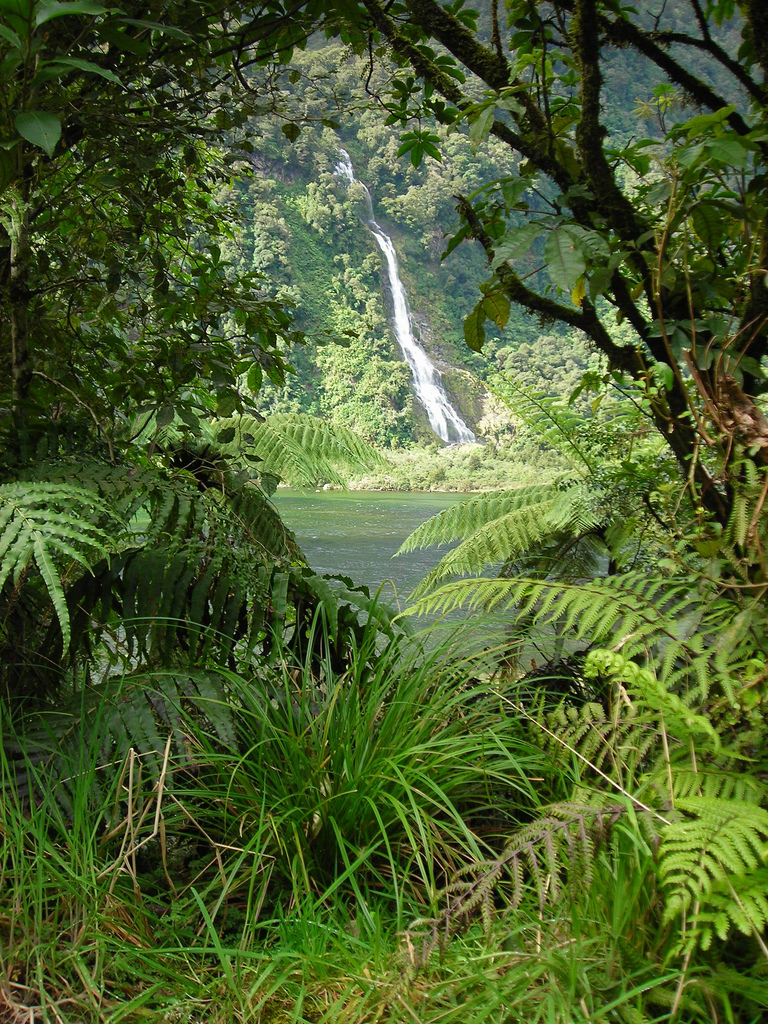
Waterfalls at Doubtful Sound
I was a bit disappointed to arrive at Lake Manapouri, the launch point for Doubtful Sound, on a dreary, rainy morning. The weather in Fjordland is notoriously wet, fickle and unpleasant. Fortunately, the initial weather conditions were meaningless. The weather on the Sound blows in from the Tasman Sea and changes every few hours. This proved exactly the case, with the weather being rainy when we embarked, misty as we neared the Tasman Sea, and then clearing up into a lovely sunny afternoon. The only environmental constant in Doubtful Sound were the swarms of sandflies, the curse of Fjordland.
I spent a glorious 4 hours cruising through the steep towering fjord cliffs, being buffeted by Tasman Sea winds, and seeing all kinds of nature up close and personal, without any crowds. There was only one other boat on the Sound that afternoon.

Seals/Sea Lions basking in the Tasman Sea. Puppies frolicking.

Dolphins chasing the boat, Doubtful Sound
So much of this place has to be seen to be believed. It is so quiet and remote that you feel like you have reached the end of the world. Or possibly the beginning of time.
 Same Skies Above
Pingback: Things I Will and Will Not Miss About New Zealand and Australia | Same Skies Above
Pingback: Fjordland: Just Like Jurassic Park… Minus the Dinosaurs. | sameskiesabove's Blog